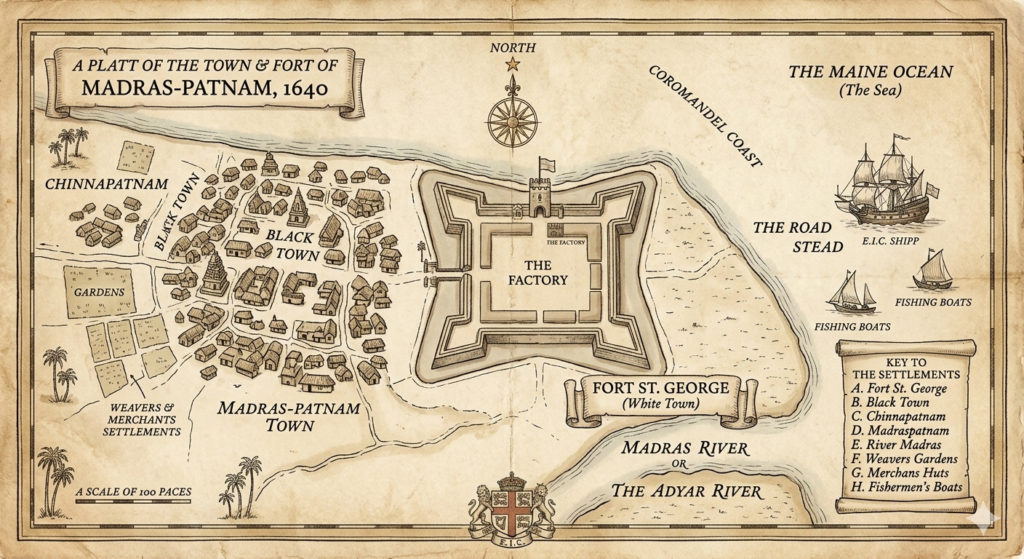
In the late 1630s, the stretch of coast where Chennai now stands was anything but a big city. There were no traffic jams, no IT corridors, not even a “Madras” on any map. There was only sea, sand, scattered coconut trees, and a cluster of fishing and weaving villages with names like Madraspatnam. Yet, on one ordinary August day in 1639, this quiet shore hosted a small meeting that would rewrite its destiny.
That meeting – a land grant between a local Nayak ruler and a group of ambitious English traders – is what we now remember as the “foundation moment” of Chennai.
A Company in Search of a Home
The British East India Company in the 1630s was restless. It had ships, soldiers, and merchants, but it did not yet rule India. Its power lay in trade, especially in pepper and textiles. On the eastern coast, it had tried operating from places like Masulipatnam and Armagon. But these posts had serious problems: political uncertainty, poor defense, and disease. The Company knew it needed a better base – a place where it could build a fort, store goods, and control its own security.
They were looking for three things:
- A coastline where ships could safely anchor.
- Nearby villages rich in cotton weaving and dyeing.
- A local ruler willing to grant land and protection.
The Coromandel Coast, along the Bay of Bengal, quietly checked all these boxes.
Enter Madraspatnam: A Village with Hidden Potential
Madraspatnam at that time was not an important city. It was a modest coastal settlement, with:
- Fishermen launching catamarans into the surf.
- Weavers producing cotton cloth in nearby villages.
- Temples and local markets serving the surrounding countryside.
From the Company’s perspective, this place had two big advantages. First, it was not dominated by their European rivals, the Portuguese and the Dutch. Second, it lay within the territory of Telugu-speaking Nayak rulers who were open to negotiation.
This is where two key figures stepped into the story.
Francis Day and Damarla Venkatadri Nayak: The Unlikely Co‑Founders
One was Francis Day – an English factor (senior trader) working for the East India Company along the Coromandel Coast. He had been sent to scout for a new site that could become a permanent English settlement.
The other was Damarla Venkatadri Nayak – a powerful local chieftain who controlled the region. He governed under the broader authority of the declining Vijayanagara successors, but in practice he had considerable freedom in his domain.
Francis Day visited this stretch of coast, studied its villages, and realized that Madraspatnam was exactly what his employers wanted: open coastline, productive hinterland, and a ruler who might see advantage in inviting foreign traders.
22 August 1639: The Land Grant
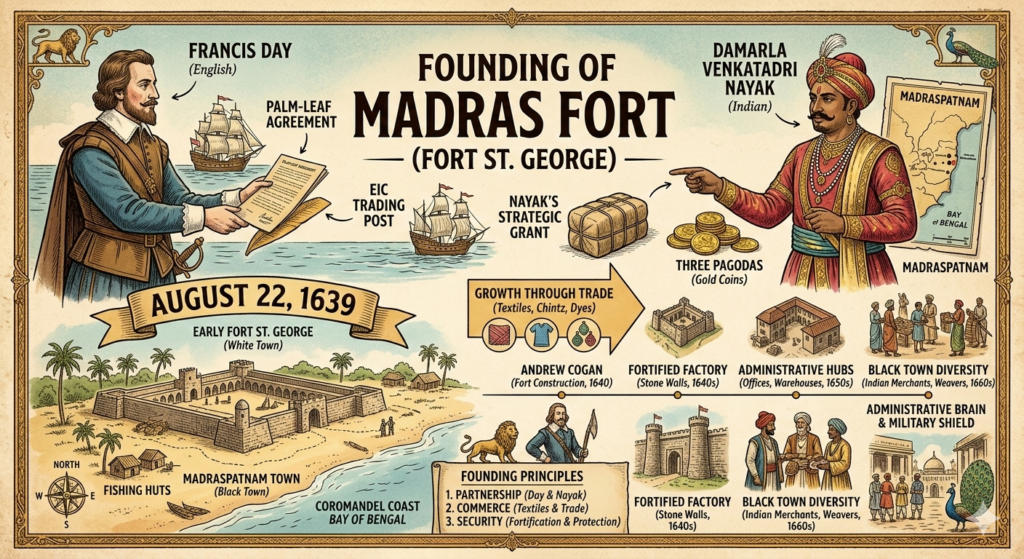
On 22 August 1639, Day and Venkatadri Nayak concluded a land grant that quietly launched a city.
The core of the agreement was simple but powerful:
- The Nayak granted the East India Company the right to use a strip of land around Madraspatnam.
- The Company could build a fortified “factory” (a trading and storage complex) there.
- In return, the Company would pay rent and offer the Nayak political and military support when needed.
In later retellings, this deal is often dramatized as the village being “bought” for three gold pagodas – a small sum. The exact financial detail is less important than the legal idea: the English now had a recognized foothold, not as conquerors, but as tenants-turned-partners.
What makes this moment so striking is how ordinary it must have looked on that day. A document, some witnesses, a few lines about land, rights, and rent. No cannons firing, no flags raised, no crowds cheering. Yet, in that quiet transaction, the foundations of Madras – and later Chennai – were laid.
From Paper to Stone: The Birth of Fort St. George
A land grant alone does not make a city. It must be followed by building. After the 1639 agreement, Francis Day’s superior, Andrew Cogan, took charge of turning the newly leased ground into something real.
In 1640, the Company began constructing a fort on the granted land. This fort would soon be known as Fort St. George.
The early fort:
- Was small and simple compared to what it later became.
- Was built using local materials and techniques.
- Had warehouses for storing textiles and goods.
- Included houses and offices for Company officials.
But its most important feature was its walls. Those walls offered security – from pirates, rival Europeans, and unstable local politics. They turned a piece of open shore into a defended base. In a world where trade, power, and security were tightly linked, that made all the difference.
The First Layers of a Town
Once the fort began to rise, people followed it.
- Merchants set up shop nearby to sell to and buy from the Company.
- Weavers and artisans from the surrounding countryside moved closer for easier access to advances and markets.
- Labourers came for work in construction, transport, and port activities.
Outside the fort walls grew a settlement that would later be called “Black Town” (today’s George Town), while the English and other Europeans lived inside and immediately around the fort in “White Town.” At this early stage, though, the whole place was still small, more like an expanded port village than a proper city.
Yet the foundation logic was set:
- A legal land grant in 1639.
- The construction of a fort in 1640.
- The steady attraction of people, goods, and money to this fortified hub.
Each of these steps traces directly back to that first agreement between Day and Venkatadri Nayak.
Why This Foundation Is Unique
Many cities have legends of heroic founders, mythic kings, or triumphant conquests. Chennai’s origin story is different and, in its own way, more modern:
- It begins with a contract, not a battle.
- It depends on mutual benefit: the Nayak gained an ally and a new source of revenue; the Company gained security and access.
- It shows how a local decision on a “small” strip of land can grow into a global story over time.
For students of history, this foundation is a textbook example of how early European influence in India often began through negotiation, land grants, and trade privileges – long before full-scale colonial rule. For residents of Chennai, it is a reminder that their city’s roots lie in a quiet collaboration between local power and foreign ambition.
The Foundation in One Picture
If you had to freeze the foundation moment as a single scene, it might look like this:
A humid coastal afternoon in August 1639. On one side, Francis Day, representing a distant trading company dreaming of profit. On the other side, Damarla Venkatadri Nayak, a regional ruler balancing local rivals and opportunities. Palm-leaf or paper documents laid out, interpreted and explained. A grant signed, a seal pressed.
Outside, fishermen still ride the waves. Weavers still spin yarn in nearby villages. None of them yet know that this small, formal act – lines of ink on a simple document – has just given their coast a new name and a new path. The world will later call it Madras. Today, we know it as Chennai.
That moment, and nothing more, is the true foundation of the city.