
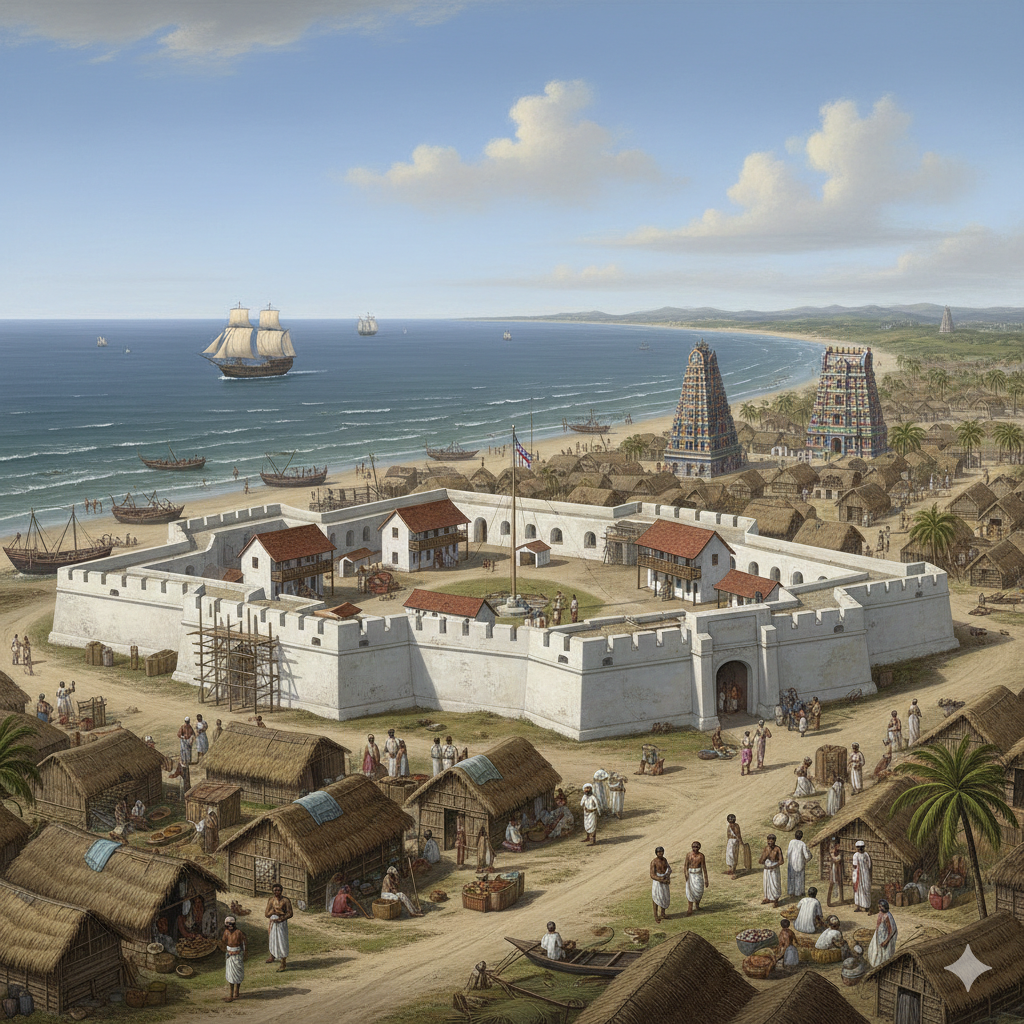
Madras, now Chennai, traces its origins to 1639 when the British East India Company established a trading settlement on the Coromandel Coast. This marked a pivotal moment in colonial history, transforming a modest fishing village into a bustling metropolis.
Pre-Colonial Context
Before British arrival, the area around modern Chennai was dotted with villages like Madraspatnam, Triplicane, and Mylapore, inhabited by Tamil fishermen and weavers under local Nayak rulers tied to the Vijayanagara Empire. The Coromandel Coast was a vibrant trade hub for textiles, spices, and gems, drawing Portuguese and Dutch merchants since the early 1600s. English traders, seeking a secure base amid rivalries, eyed this strategic bay for its natural harbor.
Key Figures and Negotiation
Francis Day, a Company agent from Armagon, played the central role in founding. In 1639, he negotiated with Damarla Venkatadri Nayaka, a Telugu chieftain and Telanga Naik of Wandiwash under the Vijayanagara viceroy at Gingee. Day’s companion Beri Thimmappa, a local Dubash (interpreter-broker), facilitated the deal. On August 22, 1639—now celebrated as Madras Day—the parties signed a firman (grant) for a three-mile coastal strip, initially leased for two years at a nominal rent.
Construction of Fort St. George
With approval from Company President Andrew Cogan in Madraspatnam by February 1640, construction kicked off rapidly. Fort St. George, named after England’s patron saint and King Charles I, was completed by April 23, 1640, featuring bastions, warehouses, and residences. It served as the Company’s fortified factory, headquarters until 1690, and later the presidency seat. Early settlers included English factors, soldiers, Armenian and Portuguese Christians, and Topasses (Eurasians).
Expansion and Governance
The lease renewed in 1642 and expanded in 1645 by Sadatullah Khan, the Golconda Nawab, granting judicial rights under English law—a rare privilege boosting settlement. “White Town” emerged inside the fort for Europeans, while “Black Town” (north and later Pedda Naikpettah) housed Indians, Armenians, and others, separated by walls against perceived threats. By 1653, Governor Joseph Pitt led amid growth; the 1670s under Sir William Langhorne saw mayoral governance formalized.
Trade Boom and Challenges
Trade flourished in calicoes, chintz, indigo, and saltpetre, exported to Persia, Europe, and beyond, drawing diverse merchants. Population swelled to 19,000 by 1649, necessitating expansions like the 1652-55 fort upgrades. Yet, threats loomed: Mir Jumla’s 1646 Golconda raid damaged but didn’t destroy it; French and Dutch rivalries intensified later. Mughal oversight grew post-1690, but Madras thrived as the Company’s strongest Indian outpost.
Urban Evolution
Villages like Triplicane (1685), Nungambakkam, and Egmore integrated, with landmarks like St. Mary’s Church (1680, Asia’s oldest British one) and the High Court (1892 precursor). By 1746, under Robert Clive, it withstood French sieges, cementing Presidency status. This colonial blueprint shaped Chennai’s grid-like Fort area, blending European forts with Indian bazaars into a resilient port city.
- Triplicane: Where Madras Began
- When a Quiet Shore Met a Restless Company: The 1639 Deal That Birthed Madras